01920 822 220
Fresh Tracks

Facilitating Adventurous Conversations

  • 01920 822 220

twitter

Posts for tag: team development

Page:             

1 2 3 5

The History of Team Buildin

The theories behind team building could be much older than originally thought.  In fact, Plato may have been the first ever team building expert!

Plato and Aristotle possibly talking about their recent team building event.

Plato & Aristotle possibly talking about their team building event.

Is team building over 2000 years old?

For some years we’ve been saying “teams that play together, work together” and it seems that although team building is thought to be a comparatively new addition to business training Plato, one of the world’s most influential philosophers, had a similar view over 2000 years ago; “You can discover more about a person in an hour of play than in a year of conversation” Plato

So we’d encourage you to make time to play with your colleagues this week, take a ball to the park, eat ice cream in the afternoon or play darts at lunchtime – whatever you think would be fun.  We spend most of our waking lives with our colleagues so let’s enjoy it.

The relationship between competiton and productivity

We all try harder when there’s a prize at stake, no matter how small.  The desire to win is in all of us to a greater or lesser extent, and even those who wouldn’t be described as ‘competitive’ still enjoy playing. Here, we look at the potential benefits of adding a bit of friendly competition within your team.

The plan to increase productivity by canceling coffee breaks flopped!

The plan to increase productivity by canceling coffee breaks flopped!

How can competition improve productivity?

By adding an element of productivity, like giving a prize to the person who has performed the best on a certain task, or praising people who have achieved a particular outcome, you might be helping create a motivated workforce. Having an element of competition can:

  • Boost motivation
  • Provide clear milestones
  • Encourage communication between peers to reach a certain goal
  • Break down set barriers in an organisation
  • Prompt creativity

Example 1: Sales

In business, sales teams have included competitive measurement and reward to drive productivity for generations with such great effect that very few sales roles exist that don’t have some form of prize built into the remuneration package.  So it’s strange that other departments haven’t created their own ways to combine play with productive working….

A guide to Belbin team roles

Fresh Tracks often uses ‘Belbin Team Roles’ to help develop teams and allow them to learn about one another’s strengths and weaknesses. But what are they and what do they do? Keep reading as we delve deeper.

What is a Belbin team role?

A Belbin team role, as defined by Dr Meredith Belbin, is: “a tendency to behave, contribute and interrelate with others in a particular way.”

What Belbin team roles are there?

There are nine different Belbin team roles that you will be scored against. These are

  1. Resource Investigator – likes researching and finding ideas to share with the team
  2. Teamworker – is a key team player and identifies ways to support the team
  3. Co-ordinator – is able to play on the team’s strengths and delegate work if necessary
  4. Plant – is very creative and is one of the ‘ideas’ people in the team
  5. Monitor Evaluator – someone who is quite logical and can weigh up different sides and views
  6. Specialist – has more detailed knowledge about specific areas that can be valuable to the team
  7. Shaper – can maintain momentum and drive change within a team
  8. Implementer – likes to work efficiently and create the necessary plan of action
  9. Completer Finisher – gets satisfaction out of completing and finishing tasks to a high quality

Check out the Belbin website for more information about the strengths and weaknesses of each role.

How do you find out your Belbin team role?

When we run team development days and events, we ususally request that teams fill out a Belbin test on the Belbin website, and then once this data has been collected, each person will be sent a report. It is often useful to print this out so you can easily turn between pages and discuss it with your team.

At our team days, we usually take the team through the report, explaining what it is, what each role is, and how you can start to make use of these. You can split off into different teams depending on who you work more closely with, to see how you can play on each other’s strengths and weaknesses.

What are the benefits of Belbin roles?

If you understand the different roles within the team, you know who likes doing what kind of work. For example, if someone scores higher in Plant, but doesn’t like actioning their ideas, another person in the team who is an implementer and a co-ordinator will help make that idea happen. Knowing this allows you to work most efficiently in a team.

Ten reasons why meetings fail

Meetings can take up a large portion of anyone’s working day, and for many of us, demands on time in the office are already high. So in an ideal world, every meeting should count, with specific objectives and results making the time invested worthwhile.

Allowing conflict to get out of control = chaos

Allowing conflict to get out of control = chaos

All too often though, meetings – even during and afterwards – are perceived as a waste of time by those invited. This can usually be attributed to a lack of understanding about what the meeting was for. To avoid the sense that it was all worthless, here is a list of ten reasons why meetings can fail for you to use as a checklist when planning your next meeting:

1.      No agenda = no purpose

Ensure you are creating an agenda for each of your meetings. This will help ensure that you are discussing the points you need and want to.

2.      No advance communication = surprising behaviours/responses

If you have created an agenda before the meeting, share this with the team members who are on the meeting invite. This will allow the other team to prepare for the meeting and collect all the information needed. It helps the meeting be smoother and more productive.

3.      Not encouraging participation = no interaction

You want team members to be engaged in the meeting and contribute the ideas they have to make the most out of the meeting. Try to prompt other people to share their ideas and take part by asking them questions.

4.      No time management = cost to organisation – time is money

If you aren’t prepared for a meeting and don’t have a clear agenda, it may take more time than is needed, which could otherwise be spent on more proactive tasks.

5.      Allowing conflict to get out of control = chaos

In a meeting, it is important to have a relatively clear structure and spot conflicts early in a meeting and ahead of a meeting. Try to bring people together and work as one team.

6.      Not reaching consensus = waste of time and company resources

If the aim of the meeting was to discuss a specific point and come to a conclusion or consensus, try to steer the conversation so each person shares their views and compromis if necessary.

7.      Allowing sub meetings = no focus or direction

If you have a meeting and decide sub-meetings are needed, this may slow down progress. If those conversations could be had in that initial meeting, try to keep them there to maintain focus.

8.      Not controlling difficult behaviour = everyone becoming difficult

This is something you should try to observe and be mindful of in a meeting. You want to ensure nobody becomes too difficult and set on one idea, rather than listening to other people, because this may cause conflicts.

9.      Not summarising actions = misunderstanding of next steps

After a meeting, it can often be useful to send a summary email or message afterwards, setting out clear next steps, assigning them to the relevant team or person if necessary. This will ensure everybody is on the same page and understands their role.

10.  Not motivational = attendees leave feeling flat and despondent

Try to stay positive during the meeting. If the meeting ends on a bad note, this may affect productivity, so it is important to try to end on a positive note and leave team members feeling energised.

This list is based on an article written by Nuggets of Learning and Development.

What is the difference between Team Building and Team Development?

Team Building vs Team Development

What is team building?

The phrase team building has risen in prominence in recent years as employers realised the value of a happy workforce where, despite their differences, team members are able to get along.  For many, team building is simply about getting away from the office for a celebratory meal, drink or day out and there is some value in this.  It creates a social context and allows colleagues space to become friends.

What is team development?

In the same way that a builder differs from a developer in the property world, team development is similar but distinctly different.  Builders will turn up and build a wall, whereas a developer sees the potential for that wall to become a terrace of houses.  Team development is a process in which a team takes time to explore its potential – how it can become greater than it’s been before….

Does “team building” work?

This is a common question people ask, and some are sceptical of the positive impacts of team building days and events. The impacts of a team day will depend very much on what the activity is, and it is important to remember that team building isn’t just about getting the team together.

Examples of bad team building scenarios

Paintballing

For example, sales executive Paul Garvey claimed that the most insightful team-building exercise he ever participated in involved paintball, which in no way helped to resolve the relationship issues back at the office. Speaking of his former company, he said that colleagues would poach each other’s deals while their manager played favourites. Someone decided a paintball exercise would help. It didn’t, and merely reinforced the divisions and favouritism already present.

Role playing

Another instance of completely inappropriate team building involved the team from a contractor on an Apollo space project. They were asked by their HR department to participate in a role-playing exercise where they had to return safely from the North Pole. Their day-to-day job involved helping astronauts return safely from space. What additional insights into teamwork did HR think this role play could teach them?…

How to spot a team player in an interview

The interviewing process can be stressful for both recruiting managers and candidates, after all, recruiting managers are trying to dissect every aspect of a candidate’s experience and personality during a short conversation. 

When interviewing for a role, hiring managers will have in mind the particular skills and qualities that they are looking for in an ideal candidate. Some of these can be more specific but there are a number of more broad and regularly desirable skills that crop up on a hiring managers ‘must-have’ list. Time and time again, being a ‘team player’ will be a significantly important trait that is sought after.

Five tips for giving better feedback

Employee engagement is undoubtedly one of the key management phrases of the moment, with home working becoming more frequent it is important that employees are feeling engaged and motivated during their working hours.

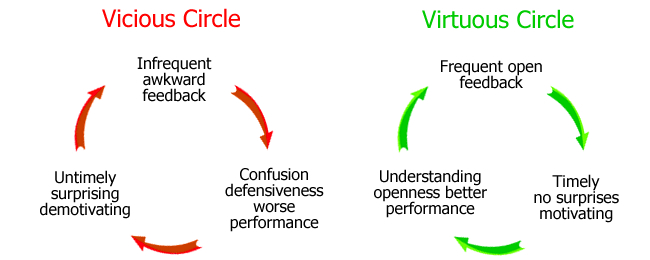
The vicious and virtuous cycles of feedback
Aim for the Virtuous Circle rather than the Vicious Circle, this can positively impact productivity & profitability.

Recent research has found that 65% of employees want more feedback from their employers, the research also found that 4 out of 10 employees that receive no feedback are actively disengaged from their work. Disengaged employees can cause a whole host of problems for employers including performance based and also financial. So how can you ensure that you are effectively providing feedback?

Page:             

1 2 3 5

Share this blog

subscribe to our RSS Feeds

Subscribe

Be among the first to get our blog posts direct to your email inbox or delivered via your RSS feed reader

Event finder question mark

Can't find what you want?

Use our Event Finder to find an event to suit your specific needs

Choose category

Browse the archives