


01920 822 220
Fresh Tracks

Facilitating Adventurous Conversations

  • 01920 822 220

Page:             

1 2 3 10

Learning from Smaller Businesses to Increase Growth

Some believe that if bigger businesses and players make a wrong move, it may be difficult for other growth opportunities to come up, so they can keep up with the pace of innovation.

One of the challenges faced by bigger companies is that they are simply too big. It is a well-worn cliché that big firms in any industry manoeuvre like oil tankers. Decision-making is slow, and attitudes to risk are conservative. For industries that are based on innovation and growth, this is more than just a frustration; it is a terminal condition.

Seth Godin, in his 2007 book ‘Small is the New Big ‘, stated that “today, little companies often make more money than big companies.” So, when an established business takes over a dynamic young enterprise, great care should be taken not to smother the youthful enthusiasm of the smaller business. In fact, the smart players know that the real value exists not just in the new entities, but in the passion and innovative drive of the team. Keep reading, as we go into a few examples of why smaller businesses are good.

Advantages of smaller organisations over large: 

More open

In an environment with fewer than 100 employees, everyone should know each other, their roles, strengths and working styles. The departmental divides that spring up in large firms don’t exist in the smaller businesses; consequently, communication is clearer, quicker and more honest.

Braver

Working for a small business is perceived to be less secure than working for a large institution, because they are thought to be at higher risk than larger companies. This bravery includes the ability to admit something is wrong. One of the greatest threats to large companies is the reluctance to call time on projects that are destined to fail.

Energetic 

A clear sense of purpose and place generates energy alongside the knowledge that every role counts. Seeing the business process from inception through to delivery is tremendously motivating and rarely communicated in large organisations.

Decisive

The closeness of relationships leads to speedy decision-making. There is no place for procrastination; leaders have to lead.

Innovative

Informality, a sense of fun and a genuine desire to serve the business all encourage original thinking throughout the entire culture.

Trusting

Gained from the sense of team that comes from having a shared goal, combined with a small community of employees. Essential if an organisation is to function efficiently.

Taking risks

Another thing larger companies should know is that entrepreneurship is not a skill that can be taught in business schools; it is an attitude that must be modelled and encouraged by leaders. It requires space in which to operate, freedom to take risks and a culture that accepts failure not as a threat but as a sign of progress.

Leaders must choose between staying big and becoming increasingly less efficient or finding new structures that encourage innovation and are places in which the brightest people want to work.

The relationship between competiton and productivity

We all try harder when there’s a prize at stake, no matter how small.  The desire to win is in all of us to a greater or lesser extent, and even those who wouldn’t be described as ‘competitive’ still enjoy playing. Here, we look at the potential benefits of adding a bit of friendly competition within your team.

The plan to increase productivity by canceling coffee breaks flopped!

The plan to increase productivity by canceling coffee breaks flopped!

How can competition improve productivity?

By adding an element of productivity, like giving a prize to the person who has performed the best on a certain task, or praising people who have achieved a particular outcome, you might be helping create a motivated workforce. Having an element of competition can:

  • Boost motivation
  • Provide clear milestones
  • Encourage communication between peers to reach a certain goal
  • Break down set barriers in an organisation
  • Prompt creativity

Example 1: Sales

In business, sales teams have included competitive measurement and reward to drive productivity for generations with such great effect that very few sales roles exist that don’t have some form of prize built into the remuneration package.  So it’s strange that other departments haven’t created their own ways to combine play with productive working….

What is the difference between Team Building and Team Development?

Team Building vs Team Development

What is team building?

The phrase team building has risen in prominence in recent years as employers realised the value of a happy workforce where, despite their differences, team members are able to get along.  For many, team building is simply about getting away from the office for a celebratory meal, drink or day out and there is some value in this.  It creates a social context and allows colleagues space to become friends.

What is team development?

In the same way that a builder differs from a developer in the property world, team development is similar but distinctly different.  Builders will turn up and build a wall, whereas a developer sees the potential for that wall to become a terrace of houses.  Team development is a process in which a team takes time to explore its potential – how it can become greater than it’s been before….

Does “team building” work?

This is a common question people ask, and some are sceptical of the positive impacts of team building days and events. The impacts of a team day will depend very much on what the activity is, and it is important to remember that team building isn’t just about getting the team together.

Examples of bad team building scenarios

Paintballing

For example, sales executive Paul Garvey claimed that the most insightful team-building exercise he ever participated in involved paintball, which in no way helped to resolve the relationship issues back at the office. Speaking of his former company, he said that colleagues would poach each other’s deals while their manager played favourites. Someone decided a paintball exercise would help. It didn’t, and merely reinforced the divisions and favouritism already present.

Role playing

Another instance of completely inappropriate team building involved the team from a contractor on an Apollo space project. They were asked by their HR department to participate in a role-playing exercise where they had to return safely from the North Pole. Their day-to-day job involved helping astronauts return safely from space. What additional insights into teamwork did HR think this role play could teach them?…

Five tips for giving better feedback

Employee engagement is undoubtedly one of the key management phrases of the moment, with home working becoming more frequent it is important that employees are feeling engaged and motivated during their working hours.

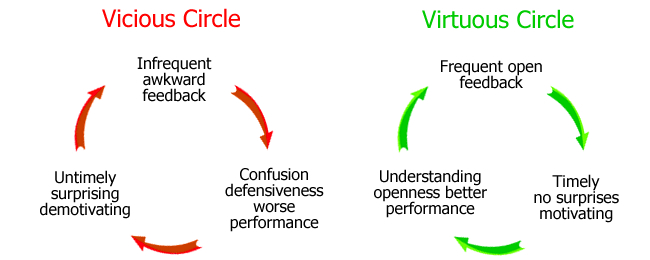
The vicious and virtuous cycles of feedback
Aim for the Virtuous Circle rather than the Vicious Circle, this can positively impact productivity & profitability.

Recent research has found that 65% of employees want more feedback from their employers, the research also found that 4 out of 10 employees that receive no feedback are actively disengaged from their work. Disengaged employees can cause a whole host of problems for employers including performance based and also financial. So how can you ensure that you are effectively providing feedback?

10 Ways To Beat Email Overload

Most of us don’t just rely on email, we are shackled to it.

Email overload has been a growing problem in recent years and has only been made worse by remote working. Instead of colleagues popping over to your desk to ask a quick question, they are now having to send emails. For the more experienced and knowledgeable employees within an organisation, this can cause a huge new influx of daily emails that they never had before and lead to email overload.

Don't let emails get out of hand

10 Tactics to Create Captivating Conferences

Are you struggling with with your post-event survey scores? Are your events lacking in engagement and value adding features? Then it is time to give your event a new itinerary, individuals attend conferences to gain learn new skills, network with new people and share professional experiences, so what can you do to encapsulate all of these whilst keeping it fun and entertaining?

Follow our tips below in order to make your next conference captivating and successful

Contrary to what speaker bureau would have us believe, it is possible to put on an outstanding staff conference without paying a premium for a celebrity to ‘motivate’ the crowd through the graveyard shift.

Page:             

1 2 3 10

Share this blog

subscribe to our RSS Feeds

Subscribe

Be among the first to get our blog posts direct to your email inbox or delivered via your RSS feed reader

Event finder question mark

Can't find what you want?

Use our Event Finder to find an event to suit your specific needs

Choose category

Browse the archives