


01920 822 220
Fresh Tracks

Facilitating Adventurous Conversations

  • 01920 822 220

Page:             

1 2 3 … 14

10 Tips To Stop Being A Busy Fool

I thought smartphones, Microsoft Outlook and open plan offices were all supposed to save us time and make us more efficient. Yet most of the middle managers I come across seem to be busier, more stressed and consequently more indecisive than ever before.

Perhaps it’s time to challenge the status quo. After all, a packed diary might fool some into thinking we are successful, but in truth it simply says we have no time to seize new opportunities, think creatively or sit down with a colleague in need. I’m always impressed that most CEO’s I deal with can make time to meet within a few days. Not so with the majority of ‘rising leaders’ who can rarely consider scheduling a meeting until “next month at the earliest.”

You might argue that the former benefit from personal assistants to help them manage their time, but I’d suggest it’s a matter of priorities and techniques. Here are 10 of the tricks I’ve picked up from those that seem to have got the balance right:

1. Be clear about your priorities

Know what your role requires of you and where you want your career to go; eliminate any activity that doesn’t relate directly to these objectives

2. Avoid committees

Committees rarely make good decisions; they spend far too much time discussing minutiae, and they steal time from your diary way into the future

3. Learn how to close a phone call

With a few well-chosen phrases. My favourite is ‘don’t let me keep you any longer ’. This way you can politely terminate the call without ending the relationship

4. Don’t get comfortable

Some of my most productive meetings have been conducted standing up and the worst, in unventilated meeting rooms in comfortable chairs

5. Break habits

Just because meetings normally start at 10 am and last for 60 minutes in the conference room, it doesn’t mean that’s the right formula. Try different durations, locations, and times depending on the urgency and desired outcome.

6. Say no if you need to

Say no, not ‘I’ll consider’ it or ‘Come back to me, next week’. Busy fools allow their mouths to operate independently to their brain, just say what you mean.

7. Ignore emails in the morning

At the very start of the day, begin by mapping out what you really need to achieve rather than allowing your Inbox to dictate your day.

8. Improve admin efficiency

If Microsoft Outlook or similar handles your email and diary, then set aside half a day to improve your knowledge of its functionality and the settings you use. Most people don’t use these systems efficiently and an hour invested in training could save you days over the next year.

9. Take action quicker

Reply, file or delete every email and letter at first sight; don’t let them loiter around, take action immediately.

10. Tell the world how you operate

If you find it best to check emails at defined times, say before 10 am and after 4 pm include a note to that effect in your email signature. Do likewise with ‘out of office’ and voicemail.

In the future, there will be yet more gadgets that need our attention; managers must take back control so that the technology doesn’t manage them.

Written by Dan Collins, founder of Fresh Tracks.


The Relationship Between Sleep and Productivity

Our relationship to tiredness is paradoxical, a source of shame, indicating our inability to cope; but also a badge of honour, signifying the importance of our work. For some its become an ‘affordable’ status symbol. In reality, tiredness leads to irritability, either bad decision-making or worse, procrastination and low productivity, poor concentration and reduced creativity. Fatigue also reduces our immunity, leading very quickly to ill health.

You cant beat a good nights sleep!

You can’t beat a good night’s sleep!

The dilemma of sleep today

In our 24/7 world, time spent sleeping is in decline, so it’s little wonder that some of us find it hard to wake up in the morning.  It’s reported that we sleep at least one hour less each night than we did a half century ago.

An American study found that during a two-week period, 40% of workers reported fatigue. Of those, 65% reported health-related lost productive time. According to the researchers, workers with fatigue cost US employers $136.4 billion annually in health-related lost productive time.

Two-thirds of adults report frequent sleep problems; however, only one in eight say those problems have been diagnosed.  The ‘sleep deprived’ are also more likely to suffer from obesity, diabetes, cardiovascular, psychiatric and gastrointestinal disease, and impaired immunity.

Sleep quality and quantity matter

So it’s not just the quantity of our sleep that matters but also the quality; snoring loudly, daytime dozing, trouble falling asleep or waking unrefreshed are just a few of the signs that a person could be ‘sleep deprived’

“Sleep is sort of like food,” says Robert Stickgold, a cognitive neuroscientist at Harvard Medical School.  He adds, there’s one important difference: “You can be quite starved and still alive. But many of us live on the edge of sleep starvation and just accept it.”…

The Mayonnaise Jar and 2 Beers: A Metaphor for Energy Levels

When things in your life seem almost too much to handle, when 24 hours in a day are not enough, remember the mayonnaise jar and the 2 Beers.

There is always time for a beer with friends

There is always time for a beer with friends

What is the mayonnaise jar and 2 beers?

The mayonnaise jar and two beers is an old story, which provides a good metaphor for energy levels, and something we can take a lot of learnings from.

The Story

A professor stood before his philosophy class and had some items in front of him. When the class began, he wordlessly picked up a very large and empty mayonnaise jar and proceeded to fill it with golf balls. He then asked the students if the jar was full. They agreed that it was.

The professor then picked up a box of pebbles and poured them into the jar. He shook the jar lightly. The pebbles rolled into the open areas between the golf balls. He then asked the students again if the jar was full. They agreed it was….

A guide to Belbin team roles

Fresh Tracks often uses ‘Belbin Team Roles’ to help develop teams and allow them to learn about one another’s strengths and weaknesses. But what are they and what do they do? Keep reading as we delve deeper.

What is a Belbin team role?

A Belbin team role, as defined by Dr Meredith Belbin, is: “a tendency to behave, contribute and interrelate with others in a particular way.”

What Belbin team roles are there?

There are nine different Belbin team roles that you will be scored against. These are

  1. Resource Investigator – likes researching and finding ideas to share with the team
  2. Teamworker – is a key team player and identifies ways to support the team
  3. Co-ordinator – is able to play on the team’s strengths and delegate work if necessary
  4. Plant – is very creative and is one of the ‘ideas’ people in the team
  5. Monitor Evaluator – someone who is quite logical and can weigh up different sides and views
  6. Specialist – has more detailed knowledge about specific areas that can be valuable to the team
  7. Shaper – can maintain momentum and drive change within a team
  8. Implementer – likes to work efficiently and create the necessary plan of action
  9. Completer Finisher – gets satisfaction out of completing and finishing tasks to a high quality

Check out the Belbin website for more information about the strengths and weaknesses of each role.

How do you find out your Belbin team role?

When we run team development days and events, we ususally request that teams fill out a Belbin test on the Belbin website, and then once this data has been collected, each person will be sent a report. It is often useful to print this out so you can easily turn between pages and discuss it with your team.

At our team days, we usually take the team through the report, explaining what it is, what each role is, and how you can start to make use of these. You can split off into different teams depending on who you work more closely with, to see how you can play on each other’s strengths and weaknesses.

What are the benefits of Belbin roles?

If you understand the different roles within the team, you know who likes doing what kind of work. For example, if someone scores higher in Plant, but doesn’t like actioning their ideas, another person in the team who is an implementer and a co-ordinator will help make that idea happen. Knowing this allows you to work most efficiently in a team.

Ten reasons why meetings fail

Meetings can take up a large portion of anyone’s working day, and for many of us, demands on time in the office are already high. So in an ideal world, every meeting should count, with specific objectives and results making the time invested worthwhile.

Allowing conflict to get out of control = chaos

Allowing conflict to get out of control = chaos

All too often though, meetings – even during and afterwards – are perceived as a waste of time by those invited. This can usually be attributed to a lack of understanding about what the meeting was for. To avoid the sense that it was all worthless, here is a list of ten reasons why meetings can fail for you to use as a checklist when planning your next meeting:

1.      No agenda = no purpose

Ensure you are creating an agenda for each of your meetings. This will help ensure that you are discussing the points you need and want to.

2.      No advance communication = surprising behaviours/responses

If you have created an agenda before the meeting, share this with the team members who are on the meeting invite. This will allow the other team to prepare for the meeting and collect all the information needed. It helps the meeting be smoother and more productive.

3.      Not encouraging participation = no interaction

You want team members to be engaged in the meeting and contribute the ideas they have to make the most out of the meeting. Try to prompt other people to share their ideas and take part by asking them questions.

4.      No time management = cost to organisation – time is money

If you aren’t prepared for a meeting and don’t have a clear agenda, it may take more time than is needed, which could otherwise be spent on more proactive tasks.

5.      Allowing conflict to get out of control = chaos

In a meeting, it is important to have a relatively clear structure and spot conflicts early in a meeting and ahead of a meeting. Try to bring people together and work as one team.

6.      Not reaching consensus = waste of time and company resources

If the aim of the meeting was to discuss a specific point and come to a conclusion or consensus, try to steer the conversation so each person shares their views and compromis if necessary.

7.      Allowing sub meetings = no focus or direction

If you have a meeting and decide sub-meetings are needed, this may slow down progress. If those conversations could be had in that initial meeting, try to keep them there to maintain focus.

8.      Not controlling difficult behaviour = everyone becoming difficult

This is something you should try to observe and be mindful of in a meeting. You want to ensure nobody becomes too difficult and set on one idea, rather than listening to other people, because this may cause conflicts.

9.      Not summarising actions = misunderstanding of next steps

After a meeting, it can often be useful to send a summary email or message afterwards, setting out clear next steps, assigning them to the relevant team or person if necessary. This will ensure everybody is on the same page and understands their role.

10.  Not motivational = attendees leave feeling flat and despondent

Try to stay positive during the meeting. If the meeting ends on a bad note, this may affect productivity, so it is important to try to end on a positive note and leave team members feeling energised.

This list is based on an article written by Nuggets of Learning and Development.

Does “team building” work?

This is a common question people ask, and some are sceptical of the positive impacts of team building days and events. The impacts of a team day will depend very much on what the activity is, and it is important to remember that team building isn’t just about getting the team together.

Examples of bad team building scenarios

Paintballing

For example, sales executive Paul Garvey claimed that the most insightful team-building exercise he ever participated in involved paintball, which in no way helped to resolve the relationship issues back at the office. Speaking of his former company, he said that colleagues would poach each other’s deals while their manager played favourites. Someone decided a paintball exercise would help. It didn’t, and merely reinforced the divisions and favouritism already present.

Role playing

Another instance of completely inappropriate team building involved the team from a contractor on an Apollo space project. They were asked by their HR department to participate in a role-playing exercise where they had to return safely from the North Pole. Their day-to-day job involved helping astronauts return safely from space. What additional insights into teamwork did HR think this role play could teach them?…

Five tips for giving better feedback

Employee engagement is undoubtedly one of the key management phrases of the moment, with home working becoming more frequent it is important that employees are feeling engaged and motivated during their working hours.

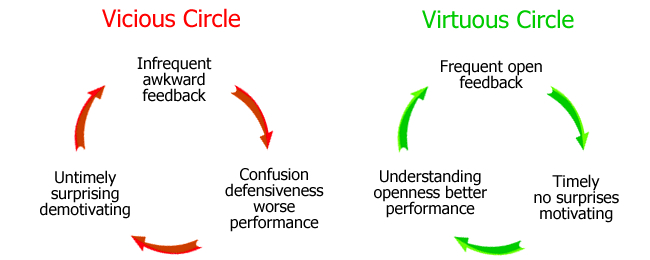
The vicious and virtuous cycles of feedback
Aim for the Virtuous Circle rather than the Vicious Circle, this can positively impact productivity & profitability.

Recent research has found that 65% of employees want more feedback from their employers, the research also found that 4 out of 10 employees that receive no feedback are actively disengaged from their work. Disengaged employees can cause a whole host of problems for employers including performance based and also financial. So how can you ensure that you are effectively providing feedback?

…

10 Ways To Beat Email Overload

Most of us don’t just rely on email, we are shackled to it.

Email overload has been a growing problem in recent years and has only been made worse by remote working. Instead of colleagues popping over to your desk to ask a quick question, they are now having to send emails. For the more experienced and knowledgeable employees within an organisation, this can cause a huge new influx of daily emails that they never had before and lead to email overload.

Don't let emails get out of hand
…

10 Tactics to Create Captivating Conferences

Are you struggling with with your post-event survey scores? Are your events lacking in engagement and value adding features? Then it is time to give your event a new itinerary, individuals attend conferences to gain learn new skills, network with new people and share professional experiences, so what can you do to encapsulate all of these whilst keeping it fun and entertaining?

Follow our tips below in order to make your next conference captivating and successful

Contrary to what speaker bureau would have us believe, it is possible to put on an outstanding staff conference without paying a premium for a celebrity to ‘motivate’ the crowd through the graveyard shift.

…

Page:             

1 2 3 … 14

Share this blog

subscribe to our RSS Feeds

Subscribe

Be among the first to get our blog posts direct to your email inbox or delivered via your RSS feed reader

Event finder question mark

Can't find what you want?

Use our Event Finder to find an event to suit your specific needs

Choose category

Browse the archives