
01920 822 220
Fresh Tracks

Facilitating Adventurous Conversations

  • 01920 822 220

Conference Facilitation & Team Building Blogs

Welcome to the Fresh Tracks team building blog. This is a growing collection of team development news, opinions, tips and advice. We would love your input so feel free to comment or get in touch.

Page:             

1 2 3 38

Ten reasons why meetings fail

Meetings can take up a large portion of anyone’s working day, and for many of us, demands on time in the office are already high. So in an ideal world, every meeting should count, with specific objectives and results making the time invested worthwhile.

Allowing conflict to get out of control = chaos

Allowing conflict to get out of control = chaos

All too often though, meetings – even during and afterwards – are perceived as a waste of time by those invited. This can usually be attributed to a lack of understanding about what the meeting was for. To avoid the sense that it was all worthless, here is a list of ten reasons why meetings can fail for you to use as a checklist when planning your next meeting:

1.      No agenda = no purpose

Ensure you are creating an agenda for each of your meetings. This will help ensure that you are discussing the points you need and want to.

2.      No advance communication = surprising behaviours/responses

If you have created an agenda before the meeting, share this with the team members who are on the meeting invite. This will allow the other team to prepare for the meeting and collect all the information needed. It helps the meeting be smoother and more productive.

3.      Not encouraging participation = no interaction

You want team members to be engaged in the meeting and contribute the ideas they have to make the most out of the meeting. Try to prompt other people to share their ideas and take part by asking them questions.

4.      No time management = cost to organisation – time is money

If you aren’t prepared for a meeting and don’t have a clear agenda, it may take more time than is needed, which could otherwise be spent on more proactive tasks.

5.      Allowing conflict to get out of control = chaos

In a meeting, it is important to have a relatively clear structure and spot conflicts early in a meeting and ahead of a meeting. Try to bring people together and work as one team.

6.      Not reaching consensus = waste of time and company resources

If the aim of the meeting was to discuss a specific point and come to a conclusion or consensus, try to steer the conversation so each person shares their views and compromis if necessary.

7.      Allowing sub meetings = no focus or direction

If you have a meeting and decide sub-meetings are needed, this may slow down progress. If those conversations could be had in that initial meeting, try to keep them there to maintain focus.

8.      Not controlling difficult behaviour = everyone becoming difficult

This is something you should try to observe and be mindful of in a meeting. You want to ensure nobody becomes too difficult and set on one idea, rather than listening to other people, because this may cause conflicts.

9.      Not summarising actions = misunderstanding of next steps

After a meeting, it can often be useful to send a summary email or message afterwards, setting out clear next steps, assigning them to the relevant team or person if necessary. This will ensure everybody is on the same page and understands their role.

10.  Not motivational = attendees leave feeling flat and despondent

Try to stay positive during the meeting. If the meeting ends on a bad note, this may affect productivity, so it is important to try to end on a positive note and leave team members feeling energised.

This list is based on an article written by Nuggets of Learning and Development.

What is the difference between Team Building and Team Development?

Team Building vs Team Development

What is team building?

The phrase team building has risen in prominence in recent years as employers realised the value of a happy workforce where, despite their differences, team members are able to get along.  For many, team building is simply about getting away from the office for a celebratory meal, drink or day out and there is some value in this.  It creates a social context and allows colleagues space to become friends.

What is team development?

In the same way that a builder differs from a developer in the property world, team development is similar but distinctly different.  Builders will turn up and build a wall, whereas a developer sees the potential for that wall to become a terrace of houses.  Team development is a process in which a team takes time to explore its potential – how it can become greater than it’s been before….

A day in the life of an event manager

From protecting the event equipment from monkeys to facilitating a team-building programme for 140 managers, event management can require a lot of different skills. Here we share an example of what a day in the life of an event manager might look like, based on an event we ran in the Caribbean a few years ago.

Sir, Im afraid this is over your weight limit.

Sir, I’m afraid you’re over your weight limit.

Getting to the Caribbean

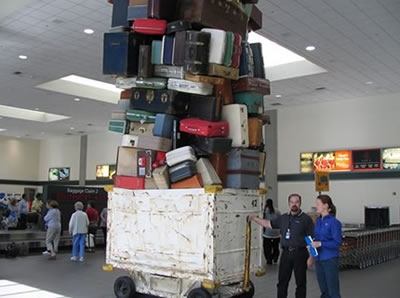
Trying to explain to the curious staff at the Virgin check-in desk quite why we needed two aluminium pyramids, 65 hoola-hoops and 140 white baseball caps was the easy part… Managing to make 200 lengths of rope, 35 pencil cases, staff uniforms, assorted event equipment and a bundle of paperwork meet the strict baggage restrictions was not so easy.

The look on the honeymooners’  and holiday makers’  faces as we struggled across the terminal with our  peculiar luggage was priceless at 5am in the morning. Little did we know what lay ahead; we faced a 9 hour flight sitting with the Barmy Army England cricket supporters also on their way to the Caribbean. Let’s just say we got no sleep whatsoever!…

Does “team building” work?

This is a common question people ask, and some are sceptical of the positive impacts of team building days and events. The impacts of a team day will depend very much on what the activity is, and it is important to remember that team building isn’t just about getting the team together.

Examples of bad team building scenarios

Paintballing

For example, sales executive Paul Garvey claimed that the most insightful team-building exercise he ever participated in involved paintball, which in no way helped to resolve the relationship issues back at the office. Speaking of his former company, he said that colleagues would poach each other’s deals while their manager played favourites. Someone decided a paintball exercise would help. It didn’t, and merely reinforced the divisions and favouritism already present.

Role playing

Another instance of completely inappropriate team building involved the team from a contractor on an Apollo space project. They were asked by their HR department to participate in a role-playing exercise where they had to return safely from the North Pole. Their day-to-day job involved helping astronauts return safely from space. What additional insights into teamwork did HR think this role play could teach them?…

How to Plan a Successful Corporate Event

If you need to plan a corporate event, you may be feeling pressure to ensure it is a successful event. However, it doesn’t need to be. We have put together a list of handy tips to help make sure you get the best out on a corporate event:

1. Be clear about your objectives

Before you even start thinking about content, the venue or even a date, you need to establish what it is you’re holding the event for. Is it to communicate a particular message,  to announce a new initiative,  to motivate staff, or purely as a social and fun occasion? In particular, ask yourself what would a successful event look like? The rest of the planning – style, content and delivery – should then refer back to these objectives….

Can teamwork save lives?

When individuals know how to work together as a team, it makes all the difference in the world. Here, we take a closer look at an example where teamwork saved lives.

Example: US Airways Flight 1549

The crew worked as a team, not as individuals—and that saved the lives of all 155 people aboard

The crew worked as a team, not as individuals—and that saved the lives of all 155 people aboard

US Airways Flight 1549 was a scheduled commercial passenger flight from New York City to Charlotte, North Carolina, that, on January 15, 2009, ditched in the Hudson River adjacent to Manhattan six minutes after departing from LaGuardia Airport.

While on its initial climb out, the Airbus A320 struck a flock of Canada Geese which resulted in an immediate almost complete loss of thrust from both engines. When the aircrew realised that the plane would be unable to safely reach any airport from its location just northeast of the George Washington Bridge, they turned it southbound and glided over the river, then ditched the airplane virtually intact near the USS Intrepid Museum in midtown Manhattan. After the 155 occupants safely evacuated the partially submerged and sinking plane they were all rescued by nearby watercraft.

The Outcome of the flight crew working together

Recently after a thorough review of the incident the National Transportation Safety Board official adamantly explained how the crew and passengers survived a near catastrophe in the incredible forced water landing on the Hudson River. “The crew worked as a team, not as individuals—and that saved the lives of all 155 people aboard”.

The message was clear: when individuals know how to work together as a team, it makes all the difference in the world.

Page:             

1 2 3 38

Share this blog

subscribe to our RSS Feeds

Subscribe

Be among the first to get our blog posts direct to your email inbox or delivered via your RSS feed reader

Event finder question mark

Can't find what you want?

Use our Event Finder to find an event to suit your specific needs

Choose category

Browse the archives